Posted on

Spill Kit Replenishment (Refill Your Kit Without Replacing)

Replen spill kits graphic

Spill Kit Replenishment (Refill Your Kit Without Replacing)

When a spill kit is used on site, many businesses assume the entire unit needs to be replaced.

In reality, most of the time only the absorbent contents need replenishing – not the wheelie bin, shovel, or broom.

If you’ve recently responded to a spill, here’s what you should know about properly refilling and restocking your spill kit.

What Does It Mean to Refill a Spill Kit?

To refill a spill kit simply means replacing the used consumable contents after a spill response.

This usually includes:

  • Absorbent pads
  • Absorbent socks or booms
  • Disposal bags
  • PPE (gloves, etc.)

The outer container and tools are typically reusable unless damaged.

Spill kit replenishment packs are designed specifically for this purpose – allowing you to restore the kit to its original capacity.

When Should You Replenish Instead of Replace?

You should refill a spill kit if:

  • Only the absorbents were used
  • The bin and tools are still in good condition
  • The kit type is still suitable for the intended spill
  • The original capacity is being restored fully

You may need to replace the entire kit if:

  • The container is cracked or damaged
  • The contents were contaminated
  • The hazard classification has changed
  • You are upgrading capacity

Why Refilling a Spill Kit Is More Cost-Effective

  • Absorbents are consumables.
  • The wheelie bin, shovel and broom are not.
  • Replacing a full unit every time a spill occurs means paying repeatedly for equipment you already have.

A spill kit refill pack allows you to:

  • Reduce replacement costs
  • Standardise stock across multiple kits
  • Maintain compliance without unnecessary capital spend

For sites with multiple spill kits, this becomes a significant cost saving over time.

Compliance Risk of Half-Empty Spill Kits

One of the biggest issues we see on sites is partially restocked spill kits.

After a spill:

  • A few pads are added back
  • Some items are forgotten
  • Capacity no longer matches the label

This creates risk during inspections and can lead to inadequate response during the next spill.

Proper spill kit replenishment ensures the kit is restored to its rated absorbency capacity.

Spill Kit Replenishment vs Spill Kit Replacement:

If the “non-consumables” are in good condition – refill.

If the non-consumables” are not in good condition – replace.

It’s that simple.

Most businesses only need replenishment packs after routine spill incidents.

If your spill kit has been used in the last 6-12 months, check:

  • Is it fully restocked?
  • Does the absorbent volume match the rated capacity?
  • Is the kit still appropriate for the substance if spilled?

If not, a spill kit replenishment may be the most efficient solution.

Spill Doctor supplies replenishment packs for oil and chemical spill kits to help businesses stay compliant without replacing entire units unnecessarily.

You can view our range of replenishment kits here: https://www.spilldoctor.co.za/product-category/spill-kits/

Posted on

Difference Between Flammable Cabinets and Normal Storage Cabinets

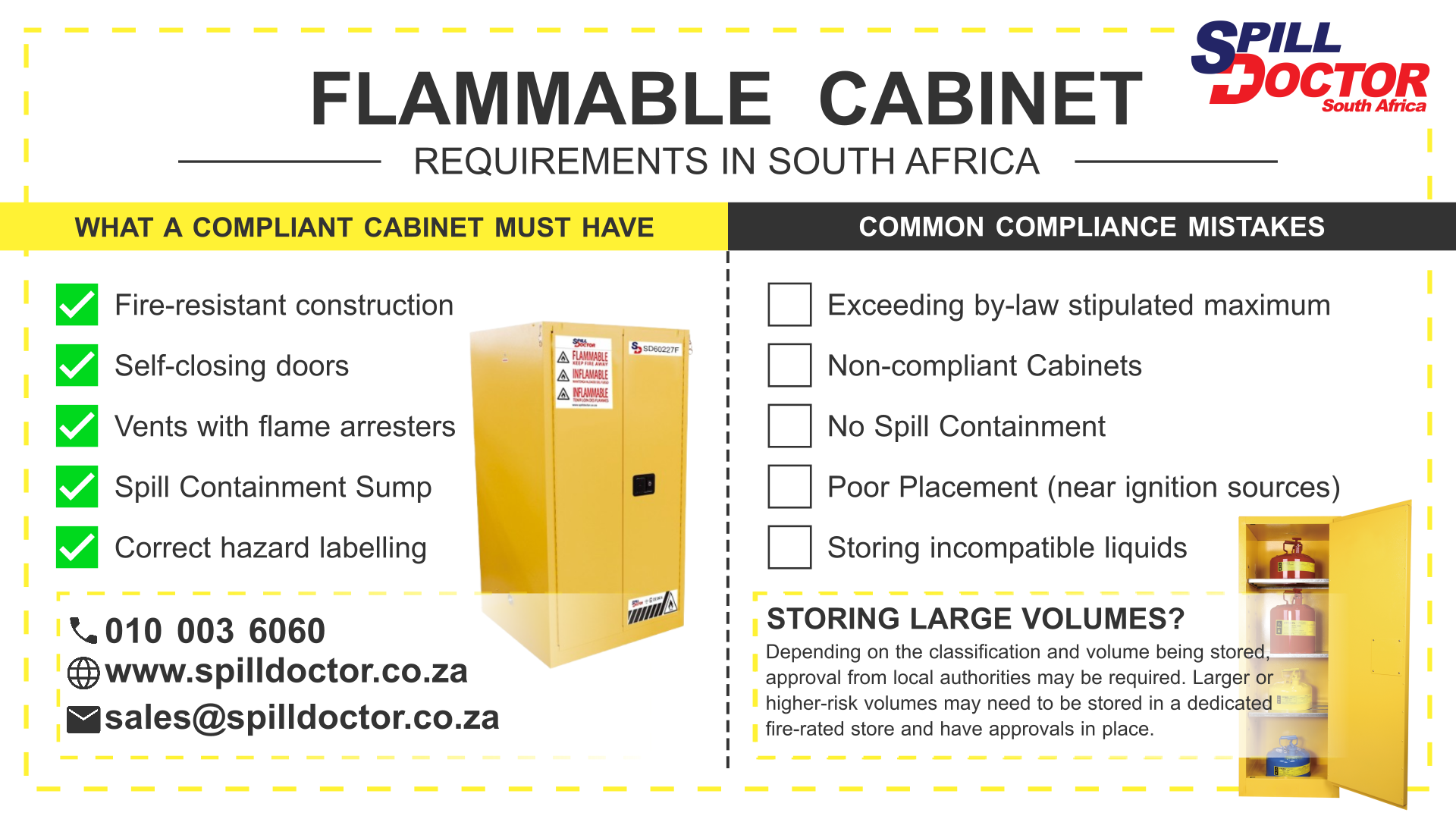
Flammable cabinets vs normal cabinets graphic

Difference Between a Flammable Cabinet and a Normal Storage Cabinet

Many workplaces store paints, solvents, thinners, fuels, or cleaning chemicals in standard metal cupboards. But when it comes to storing flammable liquids, a normal storage cabinet is not the same as a flammable safety cabinet. Understanding the difference is critical for fire safety, legal compliance, and insurance protection.

Can You Store Flammable Liquids in a Normal Cabinet?

Short answer: No.
A standard metal storage cabinet is designed for organisation — not fire protection. It does not slow heat transfer during a fire, contain flammable vapours, provide spill containment, or meet hazardous storage requirements. In the event of a fire, a normal cabinet can rapidly heat up, causing stored liquids to ignite and intensify the fire.

What Makes a Flammable Cabinet Different?

A flammable cabinet is specifically engineered to reduce fire risk and contain spills.

Key differences include:

1. Double-Wall Construction
Flammable cabinets have dual steel walls with an insulating air gap that slows heat transfer during a fire.

Normal cabinets typically have single-wall construction.

2. Built-In Spill Sump
Flammable cabinets include an integrated liquid-tight sump which is 10% of the cabinets total storage volume as per SANS54470-1.

Normal cabinets do not provide secondary containment.

3. Self-Closing Doors
Many flammable cabinets feature automatic self-closing doors to prevent accidental exposure and seal the cabinet in the event of an emergency.

Normal cabinets rely entirely on manual closing.

4. Fire Resistance Performance
Flammable cabinets are tested to withstand fire exposure for a specified period (depending on model).

Normal cabinets are not fire-rated.

5. Ventilation Design
Flammable cabinets include ventilation ports, with flame arrestors to reduce ignition risks.

Standard cabinets do not account for vapour management.

Why This Difference Matters for Compliance:

In South Africa, hazardous chemical storage is governed by safety standards and the Occupational Health and Safety framework.

Using a normal storage cupboard for flammable liquids can result in:

Fire code non-compliance

Insurance claim rejection

Increased fire risk

Environmental liability

Personal accountability for safety officers and company owners

A flammable cabinet is not simply “stronger metal.”
It is a proactive safety measure.

When Is a Flammable Cabinet Required?

A flammable cabinet is typically required when:

Storing solvents, fuels, thinners, or alcohol-based chemicals

Quantities exceed minor-use thresholds (check local municipal bylaws)

Storage is inside a building

Ignition sources are present nearby

Risk assessments identify fire exposure potential

If in doubt, a formal site risk assessment should guide cabinet selection.

Final Thoughts

A normal cabinet organises.
A flammable cabinet protects.

The cost difference between the two is minor compared to the cost of a fire incident, failed audit, or rejected insurance claim.

If your facility stores flammable liquids, choosing the correct cabinet is not optional — it is part of responsible hazardous chemical management.

You can view our range of cabinets here.

If you are still unsure which cabinet will best suit your needs, contact us here.

Posted on

Are spill kits mandatory in South Africa?

are spill kits mandatory in

Are Spill Kits Mandatory in South Africa?

“Are Spill Kits Mandatory in South Africa?” is a common question asked by SHEQ managers, workshop managers, and business owners preparing for inspections or audits. The short answer is yes, in practice, spill kits are considered mandatory, even if legislation does not always use those exact words.

What South African Legislation Says

While South African national legislation does not explicitly state “spill kits are mandatory”, it does require employers to have procedures, equipment, and measures in place to deal with hazardous spills. Some local bylaws however, maybe mention spill kits my name.

The Occupational Health and Safety Act (OHS Act section 8) places a duty on employers to provide and maintain a working environment that is safe and without risk to the health of employees. This includes managing risks associated with hazardous substances such as oil, fuel, and chemicals.

The Hazardous Chemical Substances Regulations (section 3) further require employers to prepare for incidents such as spillage, leakage, or emergency situations, and to ensure employees are properly trained and equipped to respond.

In environmental legislation (NEMA chapter 7, 28), companies can also be held liable for pollution or environmental damage caused by spills, even if the spill was accidental.

Where Spill Kits Fit In

In real-world audits and inspections, spill kits are seen as basic, essential equipment for spill response. If a spill occurs and a company does not have the means to contain and clean it up immediately, this can be viewed as a failure to take reasonable preventative measures.

As a result, inspectors generally expect to see appropriate spill kits wherever hazardous liquids are stored, handled, or transferred.

When Spill Kits Are Expected On Site

You should have spill kits available if you:

Store or handle oil, fuel, chemicals, or hazardous liquids

Use drums, IBCs, or containers that may leak

Operate machinery, vehicles, or forklifts using oils or fuels

The Bottom Line

While spill kits may not always be named word-for-word in legislation, the legal requirement to prevent and respond to spills makes them effectively mandatory.

Having the correct spill kit on site is one of the simplest ways to demonstrate compliance, reduce environmental risk, protect your business from fines, shutdowns, liability, and protect people.

You can view Spill Doctor’s range of Spill Kits here. If you are unsure which Spill Kit would best suit your needs, get in touch with us here.

Posted on

2-Hour Fire-Rated Steel Stores

2-hour fire-rated steel storesWhat Is a 2-Hour Fire-Rated Steel Store – And Do You Need One?

When working with flammable liquids like petrol, diesel, acetone, or solvents, fire safety isn’t just best practice — it’s a legal requirement. Whether you’re operating a warehouse, workshop, or production facility, safely storing hazardous materials is essential to protect your staff, comply with legislation, and maintain business continuity.

One of the most effective safety measures for flammable liquid storage is a 2-hour fire-rated steel store. But what exactly does “2-hour fire-rated” mean — and when is such a store necessary for your site?

What Does “2-Hour Fire-Rated” Actually Mean?

A 2-hour fire rating refers to how long a structure can resist fire exposure while maintaining its structural integrity and preventing internal temperature spikes. In this case, it means the steel store has been tested and certified to withstand fire conditions for 120 minutes.

This endurance is measured under standard fire test conditions, often simulating the heat curve of a structural blaze. During that time, the internal contents are protected against the full force of fire — giving emergency services time to respond and providing a crucial safety buffer for personnel evacuation.

In practical terms, it’s about containing the danger long enough to prevent disaster.

Legal Compliance: What South African Law Says:

In South Africa, the safe storage of flammable liquids is enforced under the General Safety Regulations (GSR) of the Occupational Health and Safety (OHS) Act. Specifically, GSR 4(2) states:

“No employer shall require or permit a flammable liquid to be used or applied other than in a room, cabinet or other enclosure specially constructed for this purpose of fire-resisting material or in a place which, owing to its situation or construction or any other feature or circumstance, is of such a nature that-
(a) no fire or explosion hazard is, can or may be created thereat…”

You can view the full legislation: here.

This means that if you’re storing more than minimal quantities of flammable liquids, especially indoors or near structures, a fire-rated store is likely required to meet compliance.
Failure to comply can not only result in penalties and shutdowns, but also puts your staff and assets at serious risk.

When Do You Need a 2-Hour Fire-Rated Store?

Not every situation demands a 2-hour fire-rated store, but many do. Here are typical scenarios where one is either strongly recommended or legally required:

  • You’re storing bulk quantities of Class I or II flammable liquids (e.g., petrol, ethanol, acetone).
  • The store is placed inside a building, rather than outdoors or in an isolated zone.
  • There’s insufficient separation distance between the store and other structures, walkways, roads, or personnel.
  • Your site is under strict insurance requirements or subject to a fire safety audit by local authorities or compliance officers.

In all these cases, a certified 2-hour fire-rated store offers peace of mind and may be the only acceptable solution under legal and insurance frameworks.

Features of a Compliant Fire-Rated Steel Store

A properly engineered fire-rated store isn’t just a steel box with thick walls. It incorporates a range of safety features that are essential for risk mitigation:

  • Third-party certified 2-hour fire rating
  • Built-in ventilation to prevent flammable vapour buildup
  • Compliant sump to catch leaks or spills
  • Reinforced, fire-resistant doors with secure locking

These stores are designed with both passive and active fire safety principles in mind — meaning they don’t just resist fire but actively help reduce the spread of flammable vapours and liquids.

Optional Add-Ons for Enhanced Safety

Depending on your application or risk profile, you may want to include custom options, such as:

  • Zone 1 internal lighting
  • Temperature control system
  • Pushback racking systems for drums and IBCs
  • Sprinkler system
  • Extraction system for fumes

Why It Matters

Ultimately, fire-rated storage is about more than just ticking compliance boxes. It’s about:

  • Protecting your people
  • Preventing catastrophic damage
  • Maintaining operational uptime
  • Ensures long-term legal and insurance compliance

Even a small fire can escalate quickly when flammable liquids are involved. A 2-hour fire-rated steel store ensures that, in the worst-case scenario, your risk is contained, controlled, and mitigated. Often times an insurance company will not honor a claim in the event of a fire if flammable liquids were not properly stored.

Why Choose Spill Doctor?

At Spill Doctor, we supply fully compliant, third-party certified 2-hour fire-rated steel stores, designed for South African conditions and legislation. We offer:

  • Full consultation and advice
  • Customizable configurations
  • Drawings and approvals assistance
  • Turn-key solution from drawings to delivery

Whether you need a standard unit or a fully customized fire-rated enclosure, we’ve got a solution for you.

Need help choosing a compliant fire-rated store that suits your needs?

📞 Get in touch with us: here.
🛒 Explore our full range of 2-hour fire-rated stores: here.

Posted on

Navigating South African Spill Containment Regulations

Navigating South African Spill Containment Regulations Graphic


Navigating South African Spill Containment Regulations especially when it comes to hazardous liquids and chemical storage can be tricky. South African businesses have a clear legal obligation: managing spills effectively is not optional. Proper spill containment is critical not only for environmental protection but also for workplace safety and regulatory compliance. This article breaks down the key regulations, compliance requirements, and practical steps you can take to ensure your business stays on the right side of the law.

Key Regulations Governing Spill Containment in South Africa
South Africa’s legal framework addresses spill containment through a combination of environmental laws and occupational health and safety standards:


National Environmental Management Act (NEMA) specifically Chapter 7, Section 28, businesses have a “duty of care” to prevent environmental harm. This includes taking reasonable measures to contain hazardous spills.

The National Environmental Management: Waste Act (NEM:WA) chapter 2, provides the overarching framework for waste management in South Africa, requiring businesses to comply with waste containment and handling standards as specified by national strategies and regulations developed under this Act.

Occupational Health and Safety Act (OHSA) section 8(1)(2): Employers must provide a safe workplace, minimizing workers’ exposure to hazardous substances through appropriate containment and spill management systems.

Common Compliance Requirements:


To meet these legal obligations, businesses typically need to implement:

Secondary containment systems such as spill pallets, and bunded flooring are designed to hold at least 110% of the largest container’s volume or 25% of the total volume of all containers being stored, whichever is greater as outlined in the National Environmental Management: Waste Act: NORMS AND STANDARDS FOR THE STORAGE OF WASTE (Page 12, 6.6). As well as routine inspections and maintenance of storage areas and containment equipment to identify and address risks proactively.

Challenges and Consequences of Non-Compliance

Failing to comply with spill containment regulations can result in:

  • Significant financial penalties and fines from environmental authorities.
  • Work stoppages or shutdowns imposed by regulators.
  • Damage to your business reputation through negative publicity.
  • Long-term environmental damage with costly remediation efforts.
  • Increased risk of workplace injuries or health issues for employees.

How Spill Doctor Supports Your Compliance Journey:

At Spill Doctor, We believe that proactive behaviour is necessary for the manufacturing, storage and transporting of hazardous materials or products. Should you not be prepared in the event of a spillage, your company may be liable for the environmental damage caused by the spillage which could result in hefty fines or imprisonment if found negligent. It is vitally important that you have both proactive and reactive procedures in place for any small or large spillages.

Understanding and complying with South Africa’s spill containment regulations isn’t just about avoiding fines — it’s about protecting your people, your environment, and your business. With the right knowledge and equipment, you can confidently meet legal requirements and build a safer workplace.

If you’re unsure about your current spill containment measures or need expert advice, contact us today.

Additionally, our full range or Spill Pallets, Drip trays, Drum Trolleys, etc. can be found here.