Posted on

Navigating South African Spill Containment Regulations

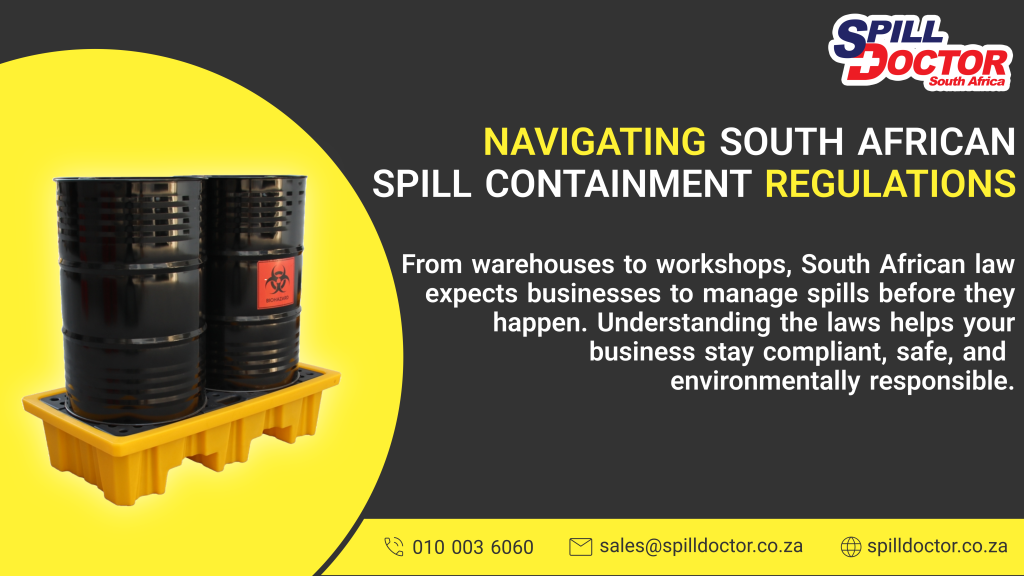
Navigating South African Spill Containment Regulations Graphic


Navigating South African Spill Containment Regulations especially when it comes to hazardous liquids and chemical storage can be tricky. South African businesses have a clear legal obligation: managing spills effectively is not optional. Proper spill containment is critical not only for environmental protection but also for workplace safety and regulatory compliance. This article breaks down the key regulations, compliance requirements, and practical steps you can take to ensure your business stays on the right side of the law.

Key Regulations Governing Spill Containment in South Africa
South Africa’s legal framework addresses spill containment through a combination of environmental laws and occupational health and safety standards:


National Environmental Management Act (NEMA) specifically Chapter 7, Section 28, businesses have a “duty of care” to prevent environmental harm. This includes taking reasonable measures to contain hazardous spills.

The National Environmental Management: Waste Act (NEM:WA) chapter 2, provides the overarching framework for waste management in South Africa, requiring businesses to comply with waste containment and handling standards as specified by national strategies and regulations developed under this Act.

Occupational Health and Safety Act (OHSA) section 8(1)(2): Employers must provide a safe workplace, minimizing workers’ exposure to hazardous substances through appropriate containment and spill management systems.

Common Compliance Requirements:


To meet these legal obligations, businesses typically need to implement:

Secondary containment systems such as spill pallets, and bunded flooring are designed to hold at least 110% of the largest container’s volume or 25% of the total volume of all containers being stored, whichever is greater as outlined in the National Environmental Management: Waste Act: NORMS AND STANDARDS FOR THE STORAGE OF WASTE (Page 12, 6.6). As well as routine inspections and maintenance of storage areas and containment equipment to identify and address risks proactively.

Challenges and Consequences of Non-Compliance

Failing to comply with spill containment regulations can result in:

  • Significant financial penalties and fines from environmental authorities.
  • Work stoppages or shutdowns imposed by regulators.
  • Damage to your business reputation through negative publicity.
  • Long-term environmental damage with costly remediation efforts.
  • Increased risk of workplace injuries or health issues for employees.

How Spill Doctor Supports Your Compliance Journey:

At Spill Doctor, We believe that proactive behaviour is necessary for the manufacturing, storage and transporting of hazardous materials or products. Should you not be prepared in the event of a spillage, your company may be liable for the environmental damage caused by the spillage which could result in hefty fines or imprisonment if found negligent. It is vitally important that you have both proactive and reactive procedures in place for any small or large spillages.

Understanding and complying with South Africa’s spill containment regulations isn’t just about avoiding fines — it’s about protecting your people, your environment, and your business. With the right knowledge and equipment, you can confidently meet legal requirements and build a safer workplace.

If you’re unsure about your current spill containment measures or need expert advice, contact us today.

Additionally, our full range or Spill Pallets, Drip trays, Drum Trolleys, etc. can be found here.

Posted on

Are You Storing Flammable Liquids Safely?

Are You Storing Flammable Liquids Safely? A Guide to Compliance & Best Practices

Flammable liquids play a crucial role in many industries, from manufacturing and logistics to laboratories and fuel stations. However, improper storage can pose serious risks, including fires, explosions, and regulatory penalties. Ensuring safe and compliant storage is not just a legal obligation—it’s a fundamental responsibility to protect your workplace and employees.

 Common Mistakes in Flammable Liquid Storage

Many businesses unknowingly put their facilities and staff at risk due to improper flammable liquid storage. Some of the most common mistakes include:

Using Non-Compliant Containers – Storing hazardous liquids in standard plastic or metal containers without proper labeling or safety features.

Improper Ventilation – Failing to provide adequate airflow around storage areas, leading to dangerous vapor buildup.

Overcrowding Storage Areas – Placing flammable materials too close together or near ignition sources.

Lack of Spill Containment – Not using spill pallets or containment systems to manage leaks and prevent environmental contamination.

Ignoring Regular Inspections – Failing to routinely check storage areas for compliance, damage, or leaks.


Legal Compliance for Flammable Storage in South Africa

Businesses handling flammable substances must adhere to South Africa’s Occupational Health and Safety Act (OHSA) and local fire regulations. Compliance requirements include:

Proper Storage Facilities – The law mandates that flammable liquids be stored in dedicated, fire-rated cabinets or steel storage units.

Adequate Fire Protection – Workplaces must have appropriate firefighting equipment, such as fire extinguishers and sprinkler systems.

Clear Signage & Labeling – All flammable liquid storage areas must be clearly marked to ensure awareness and safety compliance.

Employee Training – Workers handling these substances must be trained on safety protocols and emergency response procedures.


Standard vs. Fire-Rated Storage Solutions

Choosing the right storage solution depends on the level of risk and compliance requirements:

Standard Non-Combustible Storage

✅ Provides basic protection for non-hazardous materials.
✅ Suitable for low-volume flammable storage with minimal risk.

Fire-Rated Storage Solutions

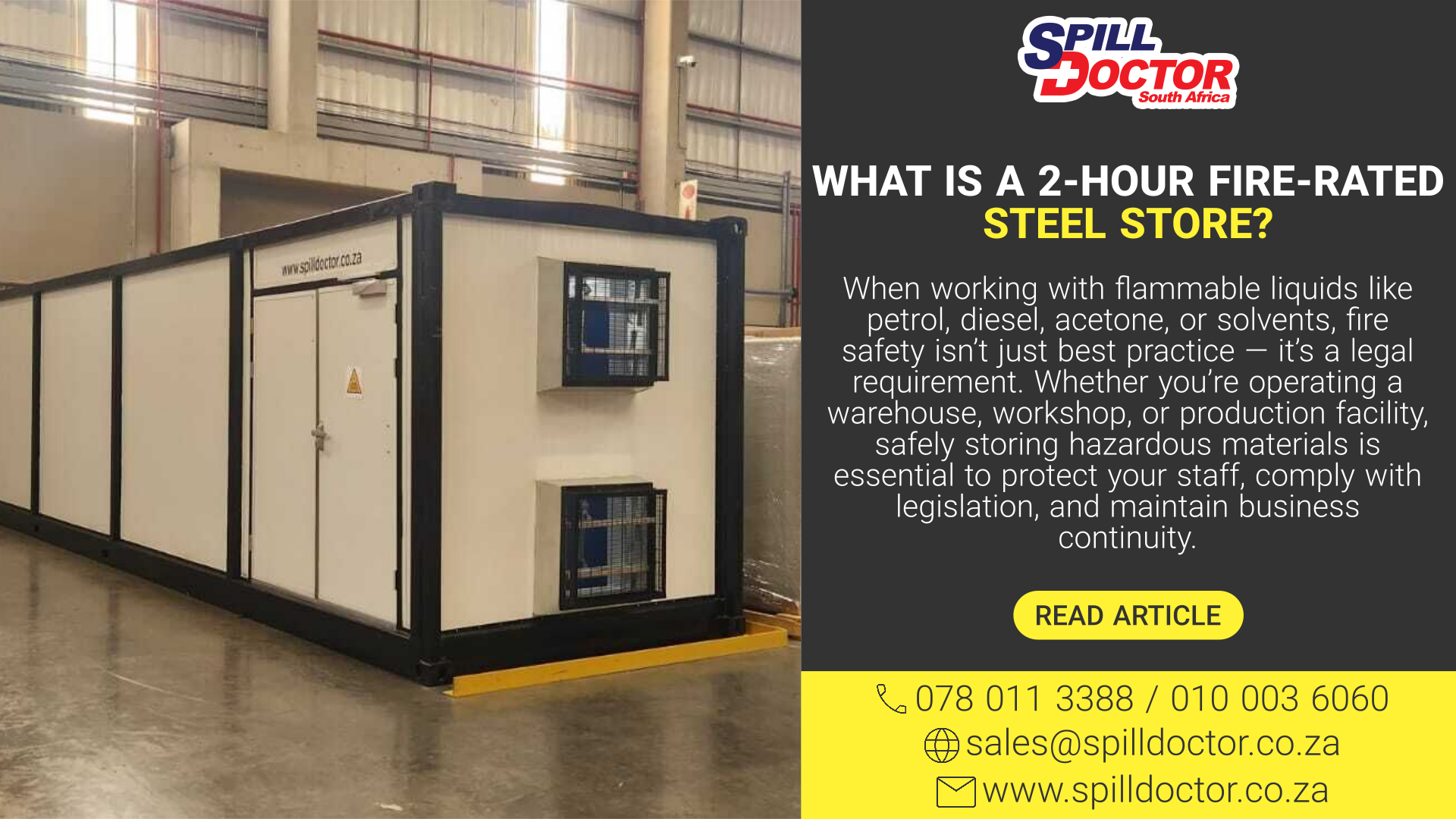
2-Hour Fire-Rated Steel Stores – Engineered to withstand extreme temperatures and prevent fire spread.
Flammable Storage Cabinets – Designed with self-closing doors, ventilation, and spill containment.
Spill Containment Solutions – Prevent leaks from spreading and reduce environmental risks.


Expert Recommendations for Workplace Safety

To ensure compliance and reduce risks, businesses should:

Invest in Fire-Rated Storage – Ensure flammable liquids are stored in certified fire-resistant units.

Implement a Spill Management Plan – Use spill kits, containment pallets, and bunding to manage leaks effectively.

Schedule Regular Safety Audits – Conduct routine inspections and address any non-compliance issues promptly.

Train Employees on Safe Handling – Educate staff on correct storage practices and emergency response.


Protect Your Business with Spill Doctor’s Flammable Storage Solutions

At Spill Doctor, we specialize in high-quality flammable liquid storage solutions that meet South African safety standards. Our range includes 2-hour fire-rated steel stores, flammable cabinets, spill pallets, and bunding solutions, ensuring your workplace is both compliant and secure.

Need expert advice? Contact us today for a free site visit or consultation.
Explore our full range of flammable storage solutions: Click Here


Posted on

OHS Act Explained – How to Keep Your Employees Safe

What is the Occupational Health & Safety Act?

The Occupational Health & Safety Act (OHS Act) was designed to ensure safety procedures and systems are implemented and followed in the workplace. The OHS Act protects employees by providing legal protection against a work environment that doesn’t follow the legislation. Without the OHS Act, employers could become lazy when implementing health and safety procedures which could lead to the workplace becoming a dangerous working environment. 

The following will outline why the Occupation Health & Safety Act is important for employers, employees and people working in health and safety industries.

According to the OHS Act, its purpose is to:

  • Protect the health and safety of persons working with equipment, machinery or hazardous materials
  • Protect external persons against hazards to health and safety arising out of or in connection to activities that may take place in a work environment
  • Establish an advisory council for occupational health & safety and provide for matters connected herewith

The sole purpose of the act is to protect employees from factors that may cause risk to their health and safety, as well as external people who may be exposed to dangerous activities and environments generated by a company (customers or people near the workplace). Employers must ensure they adhere to the procedures and requirements stipulated in the OHS Act. Any company with 20 or more employees are required to work in conjunction with a health and safety committee. The health and safety committee are tasked with identifying potential health risks. The Committee usually examine workplace incidents and investigates any complaints made by employees or external persons.

The Act also protects employers by requiring employees to take reasonable care of their health and safety as well as others while at work. It motivates employees to report any incidents or risks that an employer may not know about.

Why is the OHS Act Important?

The Act was put in place to ensure the safety of workers and the environment throughout the country. The act establishes procedures that enforce safe, productive and healthy work environments for every employee. The Act protects all persons involved in a company, from the employer to employees and customers exposed to the workplace.

Employees – 

The Act gives employees the right to a safe work environment and a platform to report any misconduct or negligence in the workplace. Employees who know the conditions of the Act can identify health and safety risks and report them to the relevant authorities. As an employee, it is your responsibility to ensure that safety practices are maintained and followed by yourself and your fellow workers. Not following health and safety requirements could result in a fine or imprisonment if you are found responsible for the damage.

Employer – 

The protection of employees and their families’ welfare should be the number one priority for all employers. Ensuring the health and safety of all workers also improves productivity in the workplace as fewer employees will be injured or fall ill. Should an employee be injured or harmed by an employer not upholding the act, they may face hefty fines or imprisonment if found guilty. Health and safety inspections happen randomly and are there to ensure that employers enforce workplace health and safety measures. Failing to adhere to the Act or not passing the inspection could result in your business temporarily closing until the correct procedures have been enforced.

How Can Employers Ensure a Safe Work Environment:

The Occupational Health & Safety Act requires employers to take responsibility for providing a safe working environment to their employees. Employers must evaluate working areas and conduct risk assessments and inspections to ensure safety measures or being adhered to. The Act also directs employers to provide preventative health and safety measures and reactive solutions in the event of an incident.

Informing Your Employees:

It is vital to explain the Occupational Health & Safety Act to employees to ensure they thoroughly understand the potential risks and hazards that may be present in the workplace. It is the employer’s responsibility to provide knowledge about OHS Act and the security measures in place to their employees. Uninformed employees won’t know what procedures to follow or the role they need to play to ensure a safe work environment for all. Not communicating this with your employees could result in failed inspections, fines, or even harm to workers or the environment.

Report Incidents or Accidents:

It is the employer’s duty to notify the Department of Labour if an employee becomes injured or falls ill. Any high-risk incidents that could be detrimental to employees, people in the area or the environment (such as chemical spills or fires), should also be reported. An investigation will be conducted to investigate the incident and to decide whether the employer and employees had followed the regulations stipulated in the OHS Act. If it is concluded that negligence and not following the proper procedures were the cause of the incident, the employer or employee will be held responsible for their actions. 

How Can Employees Ensure a Safe Work Environment:

Employees are responsible for their own health and safety and should follow the procedures and systems put in place for maximum protection. It is also their responsibility to report malfunctioning systems or other employees who may not be following the regulations. The OHS Act provides four basic rights for employees: 

  • The right to participate in health and safety regulations
  • The right to know the health and safety hazards in the workplace
  • The right to refuse work if health and safety procedures aren’t in place
  • The right to raise OHS concerns with no retaliation

In Conclusion, the Occupational Health and Safety Act was put in place to protect all those who are present in the workplace and it is the responsibility of all to implement and follow the correct procedures for maximum welfare. Not following the regulations provided in the OHS Act could result in damage to an employee’s well-being or the environment around your premises.

Posted on

8 steps to follow for spill response

Spill Doctor South Africa logo

Accidents happen, plans or steps for spill response in place for when a spill in the workplace occurs keeps you safe.

These 8 steps for spill response, which can assist you when responding to a chemical, oil or hazardous spill.

STEP 1 – ASSESS

As soon as you encounter a spill – and until it has been successfully dealt with – you must constantly assess the risk it poses to personnel, the environment, and property. You should never tackle a spill on your own. Inform colleagues and wait for at least one other person before dealing with an incident. 

STEP 2 – PROTECT

Always wear the appropriate personal protective equipment (PPE) to allow you to safely respond to the spill. Check the safety data sheet for any hazards associated with the liquid spilled and then dress accordingly. If in doubt, assume the worst and wear the highest level of PPE. For rapid response, the location of spill containment equipment should also be marked on a readily available site plan. An inventory of on-site chemicals will help responders to understand what they are dealing with. 

STEP 3 – CONTAIN

Following a spill, containment is crucial. It buys time and reduces the area of contamination, thereby lessening the spill’s impact. Use absorbent socks and booms or physical barriers to provide fast, effective containment. It is always better to try to keep any hazardous spill on the surface, so spill kits should be located next to storage areas, with sealing products positioned next to site drains.

STEP 4 – STOP THE SPILL

Once the spill has been contained, you need to stop its source, whether that involves rolling a drum damaged side up, turning off a tap, or plugging the hole in a container. If appropriate, decant any remaining liquid into a secondary container. Remember: never step in the spill.

STEP 5 – REASSESS

After the spill has been contained and the source controlled, reassess the entire situation before starting the clean-up. Ensure that the spill is fully under control.

STEP 6 – CLEAN-UP

This can be as simple as wiping up with sorbent pads, through to using additional sorbents and/or a compatible “wet vac”. Remember to treat contaminated material with the same caution as the spilled liquid itself and dispose of it accordingly.

STEP 7 – DECONTAMINATION

Ensure all personnel involved with the spill are fully decontaminated; at the spill site, all PPE and equipment must also be fully decontaminated and checked. If items have been damaged or cannot be fully decontaminated, dispose of them accordingly and replace them with new ones.

STEP 8 – REPORT AND REPLENISH

Debrief all personnel involved, compile a complete report of the incident, and fill out all associated paperwork. If need be, change your procedures and/or the location of some or all of your spill response equipment. Remember to replenish/restock all front-line equipment and backup stocks, such as PPE and drain covers. Learn from the experience; you will be better prepared should there be a next time. Staff training is paramount: they need to be familiar with the layout of the site, the equipment they will be using, and how to use it safely and effectively. Hopefully, any incident will be a rare occurrence and the only time your staff will need to respond to a spill is during regular refresher training. This training should be programmed in as a matter of course, just like any other training, such as first aid or fire extinguisher use.

You can view our range of spill kits (here).

Spill Doctor’s mission is to assist companies in creating safe and complaint workplaces by providing a range of environmental and health and safety products.