Posted on

Versatility in Safety: Spill Doctor’s Lithium Battery Storage Boxes

Versatility in Safety: Spill Doctor’s Lithium Battery Storage Boxes

At Spill Doctor, we deliver innovative and reliable safety solutions for industries across South Africa. Our mission is to supply top-tier products that prioritize workplace safety, regulatory compliance, and environmental protection. Among our advanced offerings, our lithium battery storage boxes stand out as a versatile and comprehensive solution for storing lithium-ion batteries safely and compliantly.

The development of our lithium battery storage boxes exemplifies our commitment to precision and collaboration. Partnering with one of the world’s leading automobile manufacturers, we worked closely with their engineers, both locally and internationally, to design a solution that addresses the unique risks of lithium-ion batteries. By combining Spill Doctor’s safety expertise with the engineering input of specialists, we created a product that meets stringent safety standards while aligning with the client’s operational needs. The lithium battery storage boxes are designed to withstand extreme conditions and ensure the highest level of safety. With a 2-hour fire rating, they provide crucial protection in the event of a fire, offering a critical window for emergency response.

A standout feature of our lithium battery storage boxes is the integration of vermiculite, a naturally fire-resistant material. Inside each box, vermiculite is lined and covered with a protective cloth. In the rare event of a fire within the box, the cloth burns away, releasing the vermiculite onto the flames. This immediate action suppresses the fire by reducing oxygen availability and controlling heat, ensuring that any fire is extinguished before it can escalate.

In a groundbreaking first for South Africa—and possibly worldwide—we conducted a live fire test using a third-party testing company. A vehicle battery was placed inside a Spill Doctor lithium-ion storage unit and deliberately ignited to fully assess the effectiveness of our design. The video footage, captured from inside the unit, clearly shows the fire igniting and being extinguished in as little as 30 seconds. We believe this may be the only lithium-ion storage box worldwide that has been tested in a “live” scenario, and we are extremely pleased with the results. The success of this test reinforces the exceptional safety and reliability of our design in handling lithium battery fire scenarios.

Our lithium battery storage boxes are more than just products—they are meticulously designed safety systems built to protect your workplace, employees, and assets. Backed by our expertise and commitment to excellence, we ensure that every solution is tailored to your specific needs and delivered with unmatched professionalism.

For more information about our lithium battery storage boxes and how they can enhance safety and efficiency in your workplace, contact Spill Doctor today!

Our Spill Doctor team travelled to Pretoria to conduct a live fire test, showcasing the incredible safety features of our lithium battery storage boxes. As soon as a fire ignites inside the box, a specialized cloth layer burns away, releasing Vermiculite to quickly smother the flames. This rapid response minimizes fire risks and enhances workplace safety.
Posted on

Lithium Battery Storage Boxes

Spill Doctor Pioneers Lithium Battery Storage Boxes for Enhanced Safety

Spill Doctor continues its legacy of innovation by introducing a groundbreaking solution to address the challenges posed by lithium batteries in manufacturing environments. In collaboration with one of South Africa’s largest automobile manufacturers, Spill Doctor was tasked with providing storage boxes for faulty lithium batteries encountered in the production of electric vehicles.

The journey began with close collaboration between Spill Doctor and the automobile company’s engineers, both locally and internationally. The goal was not only to tailor the design to the manufacturer’s specific processes but also to meet rigorous local and international safety standards, thus minimizing fire risks and enhancing worker safety.

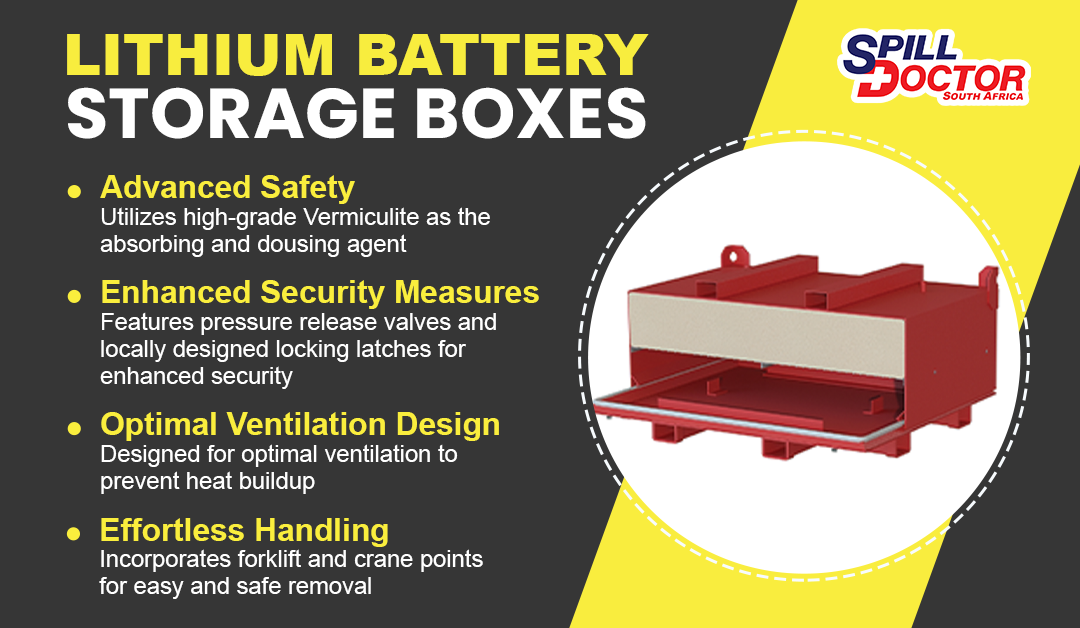
A key feature of these storage boxes is the use of high-grade Vermiculite as the absorbing and dousing agent. Vermiculite is chosen for its ability to control temperatures and absorb oxygen gases emitted during battery meltdown processes. This results in a controlled flame release, mitigating potential hazards associated with lithium battery malfunctions.

To ensure ease of handling and safety, forklift and crane points were incorporated into the design. Additionally, pressure release valves and locally designed locking latches were added for enhanced security.

With over 40 units strategically placed around the factory, these storage boxes represent a world-class solution to the growing challenges posed by lithium batteries. Spill Doctor is proud to provide an innovative and reliable solution that prioritizes safety and efficiency in manufacturing environments.

As the industry leader in hazardous material storage solutions, Spill Doctor remains committed to pushing the boundaries of innovation and setting new standards for safety and compliance.

For more information about our Lithium Battery Storage Boxes and how they can benefit your operations, please visit our website or contact us directly.

Our Spill Doctor team travelled to Pretoria to conduct a live fire test, showcasing the incredible safety features of our lithium battery storage boxes. As soon as a fire ignites inside the box, a specialized cloth layer burns away, releasing Vermiculite to quickly smother the flames. This rapid response minimizes fire risks and enhances workplace safety.

Posted on

OSH Act 16.1 Explained

Occupational Health And Safety Act Section 16 explained


Most CEO’s and managers have at some time opened their Occupational Health and Safety Act and read Section 16 and then perhaps not given it another thought?

In order to prevent unfortunate incidents which may lead to criminal or civil liability, let’s unpack what the Act says to really understand.

The OHS Act states:

16. Chief Executive Officer charged with certain duties

16.1. Every chief executive officer shall as far as is reasonably practicable ensure that the duties of his employer as contemplated in this Act are properly discharged.

16.2. Without derogating from his responsibility or liability in terms of subsection (1), a chief executive officer may assign any duty contemplated in the said subsection, to any person under his control, which person shall act subject to the control and directions of the chief executive officer.

16.3. The provisions of subsection (1) shall not, subject to the provisions of section 37, relieve an employer of any responsibility or liability under this Act.

16.4. For the purpose of subsection (1), the head of department of any department of State shall be deemed to be the chief executive officer of that department.”

Safety issues in our workplaces are governed by South African legislation which must be complied with.  Regardless how, important the CEO is, even the CEO has to comply with this legislation.

So what if we have a board of directors, or if we have a body corporate? Who will be responsible for the health and safety in the workplace and might have to face the “long arm” of the law should an unfortunate incident occur?

Occupational Health And Safety Act Section 16.1 defines the CEO as the person who is responsible for the overall management and control of the business.

Therefore, if a company has a board of directors, the board must decide who will be the person with the most authority.  The OHS Act will consider this person to be the 16.1 or the CEO as defined in Act.

According to the Act:

• Every chief executive officer shall as far as is reasonably practicable ensure that the duties of his employer as contemplated in this Act are properly discharged.

• Without derogating from his responsibility or liability, a chief executive officer may assign any duty contemplated in the said subsection, to any person under his control, which person shall act subject to the control and directions of the chief executive officer.

• The provisions of this section shall not, subject to the provisions of section 37, relieve an employer of any responsibility or liability under this Act.

Although there is only one CEO, the Act allows this person to appoint another person or persons as a 16.2. (It is impossible to imagine that the 16.1 will have the time to ensure that all the tasks in the workplace and being performed safely.)  Therefore, the 16.2 shall act subject to the control and directions of the chief executive officer.

The responsibility and liability remains with the CEO who must ensure, that the duties imposed by this Act on the employer, are properly discharged. The legislator clearly wants to ensure that these health and safety duties are properly delegated by the CEO.  The CEO can delegate responsibilities to the 16.2 but can not delegate accountability.

Section 16(3) makes provision for the CEO to be relieved of his or her responsibility and liability under certain circumstances as stipulated in section 37. Section 37 basically regulates who is liable in the case where an employee or mandatory (including contractors) does not comply with the requirements of the Act.

It is therefore, advisable to introduce a 37(2) contract if you have contractors on your site and that your employees fully understand the scope of their duties and that everything reasonably practicable has been done to ensure the health and safety of the workers. Section 37(2) will be dealt with in a later issue. In the mean time ……… stay safe!

Here is a question for all CEO’s:

Is your Health and Safety Policy current, documented and communicated to all workers in the workplace as well as available to those who may visit your workplace?  …If not contact Spill Doctor and we will assist you.